Automotive Ethernet Myths: Separating Fact from Fiction
Myth #1: Automotive Ethernet Will Replace CAN
- LIN connects simple sensors and actuators.
- CAN handles reliable, real-time control communication.
- CAN FD provides increased bandwidth for larger control messages.
- Automotive Ethernet acts as the high-speed backbone for data-intensive systems.
Myth #2: Ethernet Is Just Faster CAN
- IP-based communication
- Service-oriented architectures
- High-bandwidth data streams
- Centralized computing
- Modern diagnostics
Myth #3: Standard IT Ethernet Tools Are Good Enough
- Single-Pair Ethernet
- SOME/IP
- DoIP
- AVB and TSN
Myth #4: More Bandwidth Solves Everything
- Latency
- Jitter
- Synchronization
- Gateway routing
- Service discovery
- Network loading
Myth #5: Diagnostics Work the Same as They Always Have
Myth #6: Ethernet Makes Vehicle Networks Simpler
Reality: Ethernet simplifies architecture, not development.
Zonal architectures reduce wiring, improve scalability, and support centralized computing.
However, they also introduce new engineering challenges.
Development teams must understand:
- Mixed-network communication
- Service-oriented software
- Time synchronization
- High-speed packet analysis
- Gateway behavior
- Multi-network diagnostics
Myth #7: One Tool Can Solve Every Problem
Reality: Modern development requires an integrated toolchain.
Developing and validating today's vehicles involves multiple activities, including:
- Network analysis
- ECU interaction
- Diagnostics
- Gateway testing
- Simulation
- Data logging
- Validation
Rather than relying on a single tool, engineers benefit from solutions that work together throughout the development lifecycle.
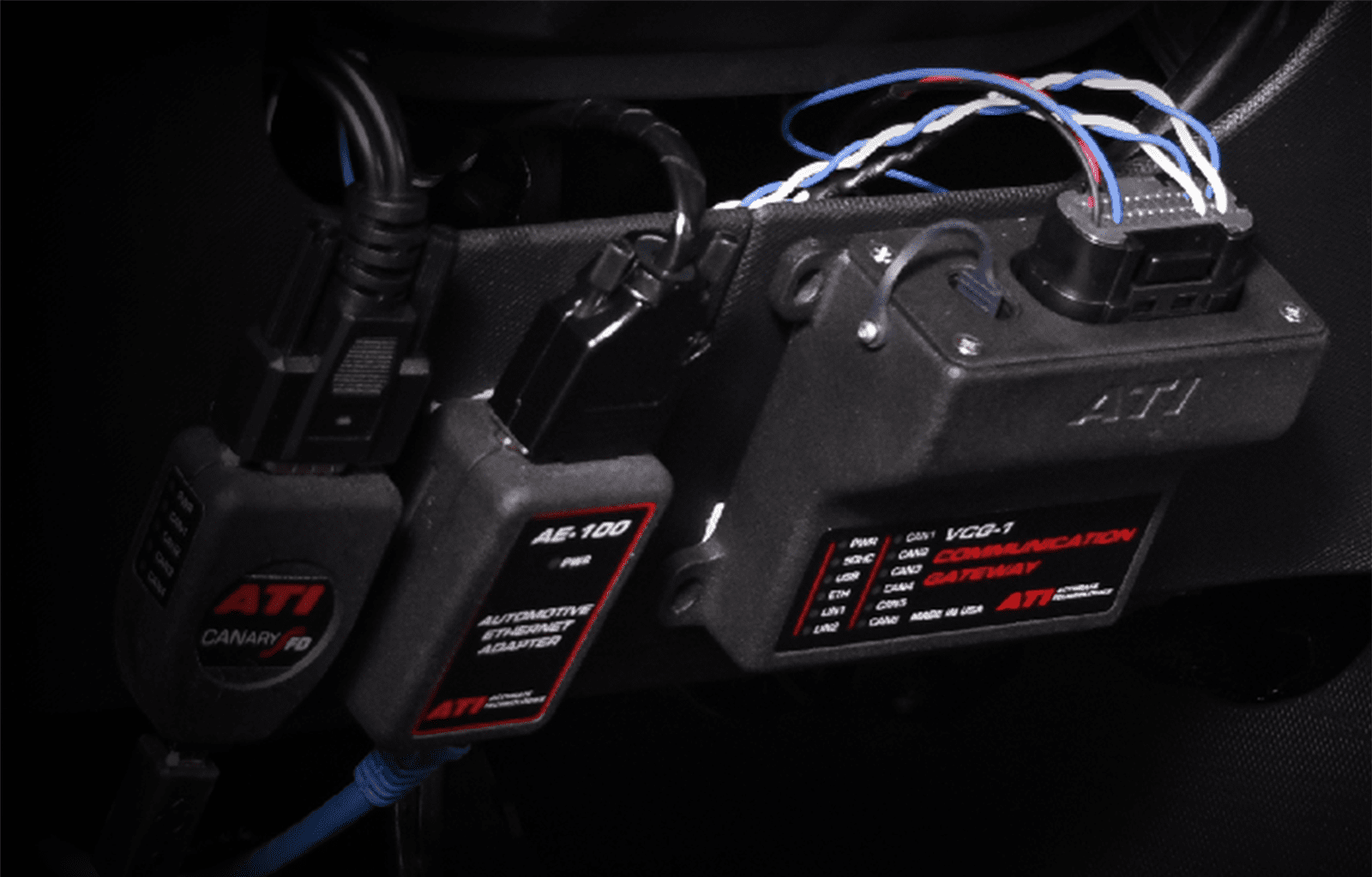
For example, CANLab provides visibility into communication across CAN, CAN FD, LIN networks. VISION supports ECU interaction and development workflows, while ATI's Vehicle Communication Gateway helps engineers bridge and validate communication between mixed-network architectures.
The Real Story
Automotive Ethernet is not replacing every existing technology.
It is enabling a new generation of vehicle architectures built around centralized computing, zonal networking, software-defined functionality, and advanced driver assistance systems.
CAN, CAN FD, LIN, and Automotive Ethernet each have a role to play. Understanding how they work together, along with the right tools to develop and validate them, is what allows engineers to build reliable, scalable vehicle networks.
Series Recap
- Why Automotive Ethernet became necessary
- How it works alongside CAN and CAN FD
- The protocols that power modern vehicle communication
- The rise of zonal architectures
- Development and validation challenges
- The tools engineers use to build and test modern vehicle networks
Continue Exploring ATI Solutions
Whether you're developing, testing, or validating mixed-network vehicle architectures, ATI provides an ecosystem of software and hardware solutions designed to support every stage of the workflow. From CANLab for network analysis to VISION for development and validation, and the Vehicle Communication Gateway for protocol translation and mixed-network communication, ATI helps engineers simplify the complexity of modern vehicle networks.