Getting Started with Automotive Ethernet Tooling
Automotive Ethernet introduces new capabilities, but it also introduces new tooling requirements.
CAN tools are still important, especially in mixed-network vehicles, but Ethernet adds packet-based communication, IP diagnostics, service discovery, synchronization, and high-bandwidth data streams. Engineers need tools that can see more than raw traffic. They need tools that understand how Automotive Ethernet behaves inside the vehicle.
Why Tooling Matters
Automotive Ethernet networks are more complex than traditional CAN networks.
Instead of only looking at message IDs and signal values, engineers may need to analyze:
- Ethernet frames
- IP traffic
- SOME/IP services
- DoIP diagnostic sessions
- AVB or TSN timing behavior
- Gateway routing
- CAN, CAN FD, and LIN interaction
Without the right tools, it can be difficult to understand where a problem starts and how it affects the rest of the vehicle network.
What Engineers Need on Day One
Getting started with Automotive Ethernet typically requires a few core capabilities.
At minimum, engineers need to be able to:
- Connect to Automotive Ethernet networks
- Monitor live traffic
- Decode common automotive protocols
- Log data for later review
- Generate or stimulate traffic
- Validate diagnostics over Ethernet
- View CAN and Ethernet behavior together
The goal is not just to capture packets. The goal is to understand what the vehicle network is doing.
Engineers also benefit from tools that provide a unified view of the vehicle network. As modern architectures combine CAN, CAN FD, LIN, and Automotive Ethernet, switching between multiple disconnected tools can slow troubleshooting and validation efforts. ATI's VISION® platform helps engineers monitor, analyze, and interact with multiple vehicle networks from a single environment.
Monitoring vs Active Testing
There are two common tooling modes: monitoring and active testing.
Monitoring means observing traffic without interfering with the network.
This is useful for:
- Debugging communication issues
- Reviewing network load
- Capturing intermittent faults
- Understanding ECU behavior
Active testing involves sending traffic, simulating ECUs, or injecting faults.
This is useful for:
- ECU bring-up
- Gateway validation
- Diagnostics testing
- Stress testing
- Reproducing edge cases
Both are important. Development teams often rely on active testing early, while validation teams need strong monitoring and repeatable test execution.
For example, engineers may use ATI's VISION® platform to monitor data that an ECU is receiving from other connected nodes. This can be used to identify message decoding issues in the ECU software. During development, these same environments can be paired with simulation and gateway solutions to actively test communication scenarios and validate system behavior.
Scaling from Bench to Vehicle
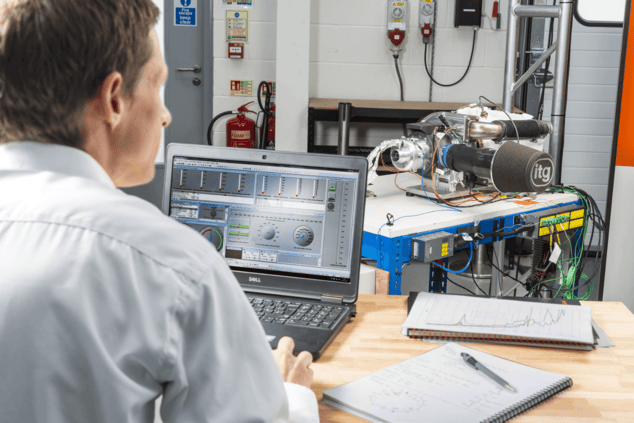
Automotive Ethernet testing usually starts on the bench.
A bench setup might include:
- One or more ECUs
- A gateway
- CAN or CAN FD networks
- An Ethernet connection
- Diagnostic or simulation tools
As development progresses, testing moves into the full vehicle. At that point, complexity increases significantly.
Engineers must validate:
- Multi-network traffic
- Gateway behavior
- Latency and jitter
- Diagnostic routing
- System-wide fault behavior
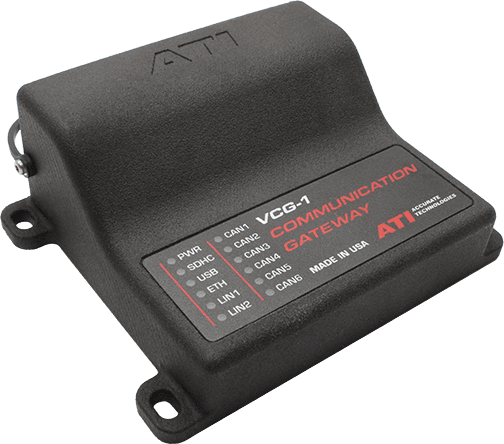
As testing progresses from bench setups to full vehicle environments, maintaining consistent workflows becomes increasingly important. Tools that support both development and validation activities help reduce rework and improve efficiency. ATI's portfolio, including VISION® and its Vehicle Communication Gateway, can be used throughout the development lifecycle, from early ECU bring-up and diagnostics to vehicle-level network validation.
Avoiding Common Beginner Mistakes
One common mistake is treating Automotive Ethernet like office Ethernet.
Standard IT tools can be helpful, but they are not enough on their own. Automotive networks require visibility into vehicle-specific protocols, timing requirements, and mixed-network behavior.
Another mistake is testing Ethernet in isolation. In most vehicles, Ethernet works alongside CAN, CAN FD, and LIN. A problem may appear on Ethernet but originate from a gateway, diagnostic route, or CAN-side message.
Effective tooling should help engineers see the whole system, not just one network segment.
What to Look for in Automotive Ethernet Tools
When evaluating tools, look for capabilities such as:
- Automotive Ethernet interface support
- CAN, CAN FD, and LIN support
- SOME/IP and DoIP decoding
- Logging and replay
- Traffic generation
- Gateway testing support
- Time synchronization analysis
- Fault injection
- Scalable bench and vehicle workflows
- Unified visibility across CAN, CAN FD, LIN, and Automotive Ethernet networks
Modern vehicle architectures require engineers to understand how multiple networks interact. Solutions such as ATI's VISION® platform are designed to provide that visibility, helping teams analyze communication, diagnose issues, and validate system behavior across the entire vehicle network.
The right tool should support both development and validation needs without forcing teams to switch workflows entirely.
Why This Matters
Automotive Ethernet is becoming a foundation for modern vehicle architectures. As networks become faster and more interconnected, engineers need tools that provide visibility across the entire system, not just individual buses. Platforms such as ATI's VISION® help development and validation teams monitor network activity, troubleshoot issues, and better understand interactions between Ethernet, CAN, CAN FD, and LIN networks.
The better the tooling, the easier it is to debug issues early, validate system behavior, and reduce risk before vehicle-level testing.
Looking to Simplify Automotive Ethernet Development and Validation?
Modern vehicles rely on a mix of CAN, CAN FD, LIN, and Automotive Ethernet networks. ATI's VISION® platform and Vehicle Communication Gateway help engineers monitor, analyze, diagnose, and validate communication across these mixed-network environments, supporting both development and validation workflows from the bench to the vehicle.
Up Next
In the next post, we will look at common Automotive Ethernet myths and what actually breaks in real-world development and validation. From "Ethernet isn't deterministic" to "Ethernet will replace CAN," we'll separate fact from fiction and examine the challenges engineers actually encounter during development.