ASAM MDF4 Explained Part 4
Modern vehicle development produces an enormous amount of measurement data. A single test may involve thousands of signals collected at different sampling rates, multiple vehicle networks, and hours of continuous recording.
As the volume of data increases, so does the challenge of storing, accessing, and analyzing it efficiently.
In Part 3 of our ASAM MDF4 Explained series, we explored how MDF4 transforms raw measurement values into meaningful engineering signals while preserving timing information.
Now, we'll look at how MDF4 handles the growing volume and complexity of measurement data, including its storage structure, compression capabilities, and the considerations involved in working with large recordings.
Why Measurement Files Get So Large
Consider a vehicle test recording 1,000 channels at a sampling rate of 1,000 samples per second.
That produces:
1,000 channels × 1,000 samples/second = 1 million samples per second
Over a one-hour test, that becomes:
3.6 billion samples
If each sample requires four bytes of storage, the raw sample values alone would occupy approximately 14.4 GB, before accounting for timestamps, metadata, record organization, and other information.
And that is only one test.
Vehicle development programs may involve hundreds or thousands of recordings collected across different vehicles, operating conditions, calibration configurations, and test environments.
Managing this volume of information requires more than simply increasing available storage.
The file format also needs to support practical access to the measurements.
MDF4 Was Designed for Complex Measurement Data
Unlike general-purpose text formats, MDF4 uses a binary structure specifically designed for measurement data.
As discussed in Part 2, MDF4 organizes information into interconnected blocks describing channels, channel groups, data groups, conversions, and recorded values.
This structure allows the format to accommodate measurements with different data types, sampling rates, and acquisition characteristics.
For example, a single recording might include:
- High-frequency engine speed measurements
- Battery voltage and current signals
- Slower temperature measurements
- CAN and CAN FD network traffic
- Diagnostic information and test events
These measurements do not necessarily share the same recording frequency or data structure.
MDF4 can preserve these differences without requiring every measurement to be converted into a single uniform table.
This flexibility is particularly valuable when collecting information from multiple systems during the same test.
How MDF4 Stores Measurement Records
In MDF4, measurement values are stored in data blocks, while other blocks describe how those values should be interpreted.
The organization of these records can vary depending on the recording system and the data being collected.
For example, measurements may be stored as records containing values from several channels acquired together.
Other recordings may contain multiple record types, including records with different structures or lengths.
This means that reading a particular signal can require more than simply locating one column of values.
An analysis application may need to identify the correct data group, interpret record identifiers, locate the channel within each record, and extract the requested samples.
The underlying structure gives MDF4 flexibility, but it also means that file organization can influence how efficiently individual signals are accessed.
MDF4 Compression: Reducing Storage Requirements
One of MDF4's important capabilities is support for compressed measurement data.
Compression helps reduce the amount of storage required for recordings, particularly when large quantities of data contain patterns or repeated information.
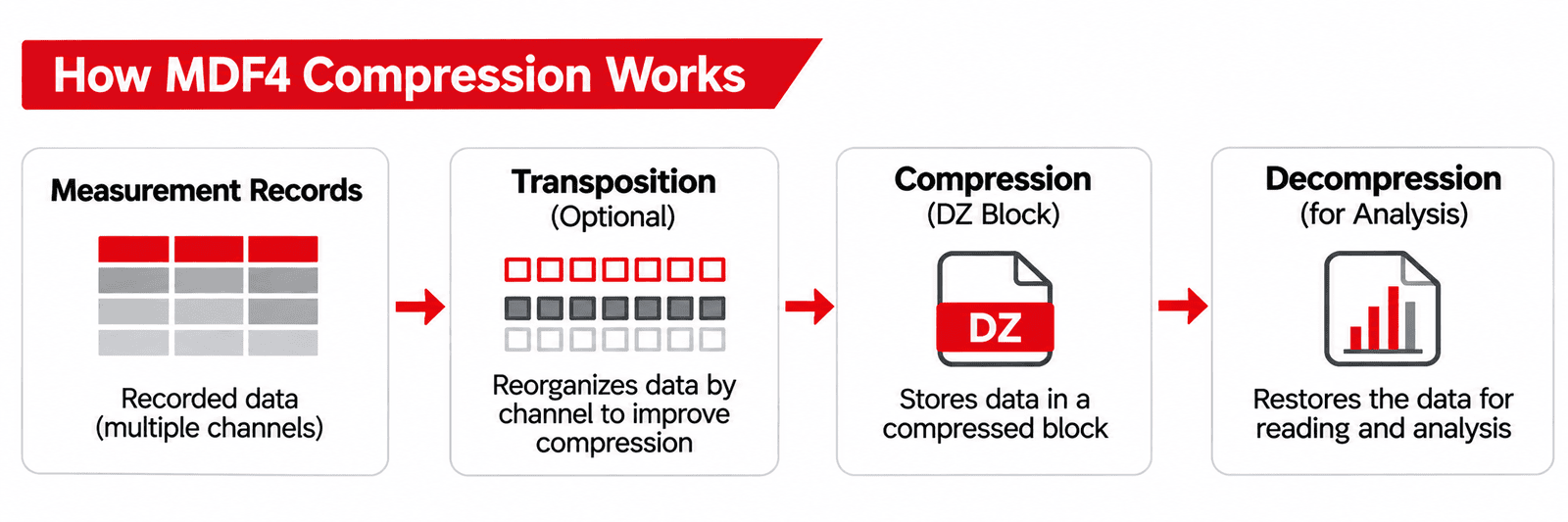
MDF4 supports compressed data through Data Zipped Blocks (DZ).
These blocks contain compressed data that can be decompressed when the measurements are accessed.
Rather than requiring the entire file to be compressed as one continuous stream, MDF4 can organize compressed data into blocks.
This allows applications to work with portions of a recording without necessarily decompressing every measurement in the file.
However, the efficiency of this process depends on how the recording was organized and how the analysis application accesses it.
Compression and Transposition
MDF4 also supports a technique known as transposition before compression.
To understand why this can help, consider a recording where each measurement record contains several channels.
When the records are stored sequentially, bytes belonging to the same channel may be separated by bytes belonging to other channels.
Transposition reorganizes the byte layout before compression, potentially placing similar byte patterns closer together.
This can improve compression effectiveness for certain types of measurement data.
The important distinction is that transposition changes how the data is arranged for compression, not the engineering meaning of the recorded measurements.
When the data is read, the original record layout can be reconstructed.
Compression reduces storage requirements, while decompression and reconstruction restore the data needed for analysis.
Smaller Files Do Not Always Mean Faster Analysis
Compression introduces a tradeoff.
A compressed MDF4 recording may require less disk space and less data transfer, but accessing its contents requires additional processing.
For example, an engineer might want to examine only engine speed from a recording containing hundreds of channels.
Depending on how the records were stored and compressed, the analysis application may need to:
1.Locate the relevant data blocks.2.Decompress the required blocks.3.Reconstruct the record layout if transposition was used.4.Extract the engine speed samples.5.Apply any necessary channel conversion.
This means that extracting one signal does not always involve reading only that signal's values from storage.
The amount of work required depends on the file structure, compression settings, record organization, and software implementation.
Compression can reduce file size, but it does not automatically guarantee faster signal extraction.
Working with Large MDF4 Files
As recordings become larger, efficient data access becomes increasingly important.
Loading an entire multi-gigabyte measurement file into memory may be unnecessary when an engineer only needs to investigate a short event or compare a handful of signals.
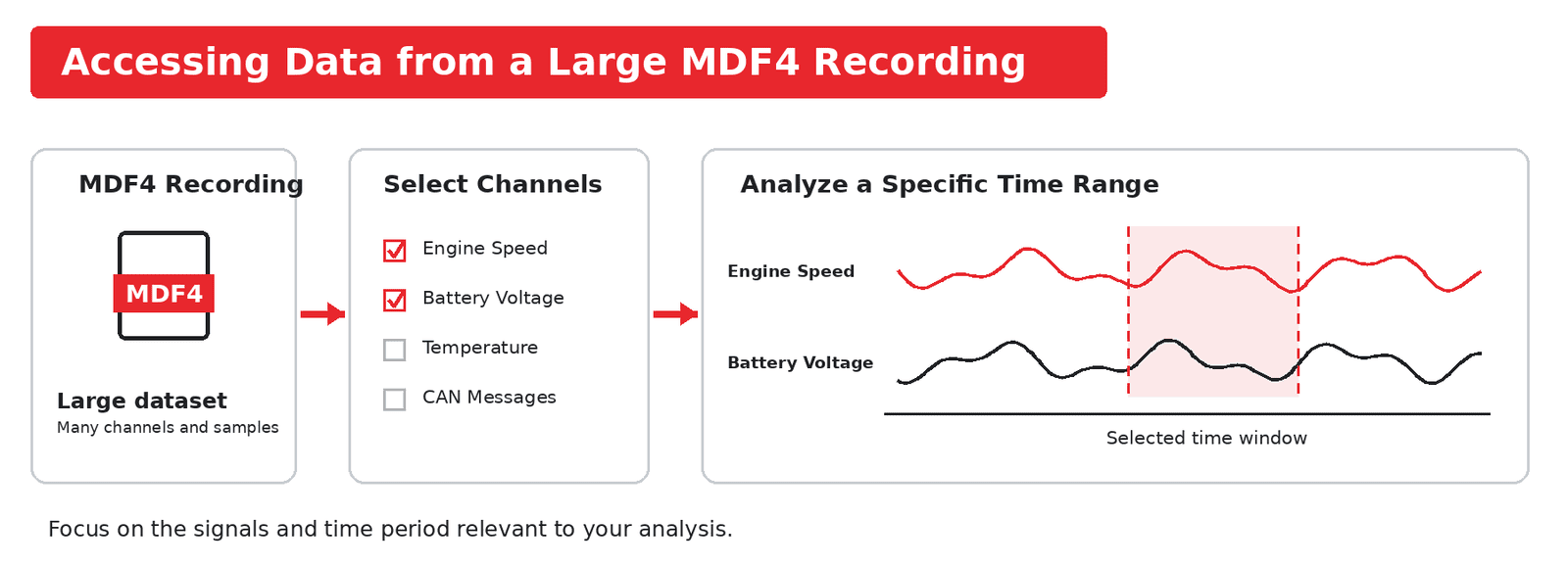
Analysis software can use different strategies to manage large recordings, including:
- Selective channel access: Retrieving only the signals required for a particular analysis.
- Time-range selection: Working with a specific portion of a recording rather than the entire test.
- Block-based processing: Reading and processing data in manageable sections.
- Caching: Retaining previously accessed information to reduce repeated processing.
- Data reduction for visualization: Displaying representative information when the number of recorded samples exceeds the available screen resolution.
These approaches are application-level techniques rather than guarantees provided by the MDF4 standard itself.
Their effectiveness depends on how the analysis software is designed and how the MDF4 file was created.
Why File Structure Affects Performance
Two MDF4 files containing similar measurements may behave differently during analysis.
One recording might open quickly and allow individual signals to be accessed efficiently, while another might require more processing.
Several factors can contribute to these differences.
Record Organization: MDF4 supports sorted and unsorted data organization. Sorted data groups contain records from a single channel group, which generally makes accessing specific measurements more efficient. Unsorted data groups can contain interleaved records from multiple channel groups, allowing data to be recorded as it arrives, which can be more efficient during logging. However, extracting individual channels from unsorted data may require additional processing.
Compression: Compressed blocks must be decompressed before their contents can be interpreted.
Block size: Larger compressed blocks may improve compression efficiency but can increase the amount of data that must be processed for a small extraction.
Channel count: Large numbers of channels increase the amount of metadata and record information an application may need to manage.
Storage performance: Reading data from a fast local SSD can behave differently from accessing the same file over a network connection.
These factors help explain why MDF4 analysis performance depends on more than the size of the file alone.
From Storage to Analysis
The ability to store large measurement datasets is valuable only if engineers can work with the recorded information afterward.
In a typical development workflow, an MDF4 recording may need to be opened, visualized, compared with other tests, and used to investigate specific operating conditions or unexpected behavior.
MDF4-compatible analysis tools handle the underlying file structure so engineers can focus on the measurements themselves.
For example, ATI's VISION Data Analyzer (VDA) supports ASAM MDF4 files, including recordings generated by third-party systems. Its 64-bit architecture supports working with large measurement datasets, while visualization and analysis capabilities help engineers explore recorded signals.
The MDF4 standard provides the structure for storing and exchanging measurement information. Analysis applications provide the tools for interpreting that information and using it in engineering workflows.
MDF4 vs. CSV for Large Recordings
CSV remains useful for exchanging simple datasets, creating reports, or transferring selected measurements into general-purpose analysis applications.
However, CSV and MDF4 serve different purposes.
CSV typically represents information as text arranged in rows and columns. It does not inherently define measurement-specific concepts such as channel conversions, multiple master channels, or structured measurement metadata.
MDF4, on the other hand, is designed to preserve these relationships within the recording.
For large or complex measurements, this distinction matters.
Converting CSV data to MDF4 can also offer advantages, particularly when working with large measurement datasets. Importing CSV data into an MDF4-compatible analysis tool, such as ATI's VISION Data Analyzer (VDA), allows engineers to take advantage of measurement-focused visualization and analysis capabilities that traditional spreadsheet applications may not provide. VDA can convert imported CSV data into MDF4, making it easier to work with large datasets, visualize signals, and perform detailed post-analysis.
Neither format is universally better. MDF4 is designed for structured measurement data and advanced analysis, while CSV remains useful for simple data exchange and compatibility with other applications.
Why Understanding MDF4 Performance Matters
Most engineers do not need to know exactly how a compressed data block is constructed or how individual measurement records are decoded.
However, understanding the basic principles behind MDF4 storage can help explain common analysis challenges.
Why does one recording take longer to open than another?
Why can extracting a single channel require processing more data than expected?
Why might a compressed file be smaller but take longer to read?
Why can exporting a recording to CSV produce a much larger file?
The answers often come back to how the measurement data is organized, compressed, and accessed.
MDF4 provides a flexible structure for storing complex recordings, but efficient analysis also depends on the software reading those recordings.
What's Next: MDF4 Beyond Signals: CAN, LIN, and Other Vehicle Data
So far, we've focused primarily on measurement signals, timestamps, conversions, and storage.
But modern vehicle testing involves more than conventional signal-versus-time recordings.
Vehicle networks generate messages, events, and other information that engineers often need to examine alongside measured values.
In Part 5 of our ASAM MDF4 Explained series, we'll explore how MDF4 can support CAN, CAN FD, LIN, and other vehicle data, and why preserving this information alongside measurement signals can be valuable during development and testing.