Part 1 - ASAM MDF4 Explained
Modern vehicle development generates enormous amounts of measurement data. Whether engineers are calibrating an ECU, validating a control strategy, testing a powertrain, or recording data from a vehicle network, hundreds or even thousands of signals may need to be captured simultaneously.
Storing those measurements is only part of the challenge. The data also needs context: What does each signal represent? What are its units? How should a raw value be converted into a physical value? When was each sample recorded? How are signals with different sampling rates synchronized?
This is where ASAM MDF (Measurement Data Format) comes in.
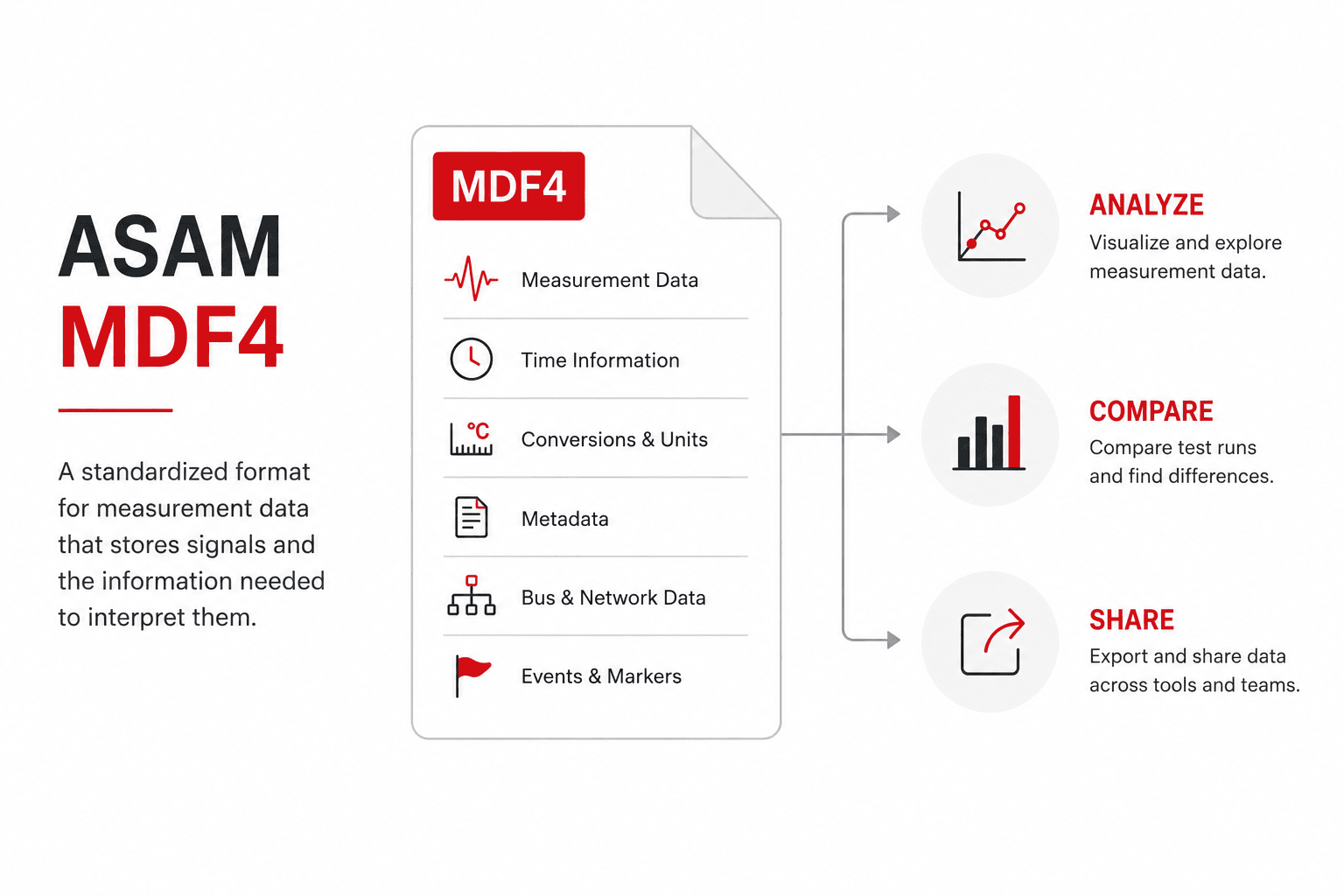
MDF is a standardized binary file format designed for storing measurement data together with the information required to interpret it. MDF4, the fourth major generation of the standard, was designed to support the increasingly large and complex datasets produced by modern automotive development and testing.
What Is ASAM MDF?
MDF stands for Measurement Data Format. The standard is maintained by ASAM (Association for Standardization of Automation and Measuring Systems) and is widely used for measurement and test data, particularly in automotive development.
An MDF file is more than a collection of recorded values. It can contain both the measurement samples and metadata describing those measurements.
Depending on the recording, this can include information such as:
- Signal and channel names
- Raw measurement values
- Physical units
- Conversion information
- Time information
- Sampling information
- Descriptions and other channel metadata
- Events and attachments
- Vehicle network data
Keeping this information together makes MDF useful for exchanging measurement data between acquisition, calibration, validation, and analysis tools.
Files based on MDF 4.x commonly use the .mf4 file extension.
Why Does a Standard Measurement Format Matter?
Consider a relatively simple test.
An engineer records engine speed, temperatures, pressures, pedal position, ECU parameters, and CAN traffic during a vehicle test. Some measurements may be sampled every millisecond, while others are recorded much less frequently.
A simple tabular format can represent some of this information, but it quickly becomes inefficient as recordings become larger and more complex.
There are several questions the file format needs to answer.
How do signals with different sampling rates coexist? How are timestamps represented? How is a raw ECU value converted into an engineering unit? How can very large recordings be stored efficiently? How can another application interpret the recording without knowing the details of the original acquisition system?
MDF was created to provide a standardized way of representing this type of measurement data.
That standardization is important because the application recording the data does not necessarily have to be the application analyzing it.
Why MDF4?
Earlier versions of MDF had already established the format within automotive measurement and calibration workflows. However, measurement systems continued to evolve.
ECUs became more complex. The number of measurable parameters increased. Vehicle networks generated more data. Sampling rates increased. Test durations became longer.
As a result, measurement files could become extremely large.
MDF4 introduced an architecture better suited to these requirements while retaining the core idea behind MDF: store measurement data together with enough information to correctly interpret it.
One of the key characteristics of MDF4 is its block-oriented structure.
Instead of treating a measurement file as one large table, MDF4 organizes information into interconnected blocks. Different blocks can describe the file, data groups, channel groups, individual channels, conversions, actual measurement data, events, attachments, and other information.
This architecture gives MDF4 considerable flexibility.
For example, a recording can contain multiple groups of measurements with different structures and timing characteristics rather than forcing every measurement into one universal sample rate.
We'll look much more closely at this block structure in the next article in this series.
MDF4 Is More Than Signal Values
When engineers first encounter an MF4 file, it is easy to think of it as simply a container for signal-versus-time data.
There is considerably more happening underneath.
Imagine that a measurement system records an ECU parameter as the integer value: 2150
That number alone may not tell an engineer very much.
The MDF4 file can also describe the channel, its unit, and the conversion needed to turn the stored value into a meaningful physical value.
The result might be something such as: 21.5 °C
This distinction between stored/raw values and physical engineering values is fundamental to working with measurement data.
MDF4 can preserve the information needed to make that interpretation part of the dataset rather than relying entirely on external knowledge.
Handling Different Sampling Rates
Another important measurement challenge is time.
Not every signal in a vehicle or test system is acquired at the same rate.
For example:
- One group of signals might be sampled every 1 ms.
- Another might be sampled every 10 ms.
- A slower temperature measurement might update every 100 ms.
- Network messages may arrive according to their own timing.
Trying to force all of this information into one large table can result in duplicated timestamps, empty values, interpolation, or unnecessarily large files.
MDF4 provides structures that allow related channels and their timing information to be organized efficiently.
This is one reason understanding concepts such as data groups, channel groups, channels, and master channels becomes important when working with MDF4.
Designed for Large Measurement Files
Measurement files can grow quickly.
Recording 1,000 channels at high sampling rates for an extended test can generate millions (or billions) of individual samples.
MDF4 includes mechanisms intended to make storing and accessing these datasets practical. Among them are support for compressed data blocks and structures that allow measurement data to be organized according to how it was acquired.
These features also introduce an important distinction between MDF4 and simpler formats such as CSV.
CSV is extremely useful when data needs to be human-readable or easily exchanged with general-purpose applications. But representing a large, complex measurement recording as rows and columns can significantly increase file size and lose some of the richer structure associated with the original measurement.
MDF4 was designed specifically around measurement data.
Where Is MDF4 Used?
MDF4 is particularly common in automotive engineering, although its underlying concepts apply to other measurement environments as well.
Typical applications include:
- ECU calibration
- Vehicle testing
- Powertrain development
- Electrified powertrain and battery testing
- Controls development
- Validation and verification
- Data acquisition
- Vehicle network recording
- Test bench measurements
- Measurement data exchange and post-processing
A common workflow might look like:
Measurement → MDF4 recording → Analysis → Engineering decision
The recording application captures the test in MDF4, and engineers can then use an MDF4-compatible analysis application to inspect signals, compare tests, calculate derived quantities, or investigate events.
For example, ATI VISION Data Analyzer (VDA) can work with MDF4 measurement files for post-processing and analysis, including MDF4 files generated by third-party measurement systems. This illustrates one of the practical advantages of using a standardized measurement format: acquisition and analysis do not necessarily need to happen in the same software environment.
MDF4 vs. MDF3
MDF3 files are still encountered in existing measurement environments, so it is useful to understand that MDF4 is not simply MDF3 with a new file extension.
MDF4 introduced substantial changes to the underlying file architecture to better accommodate modern measurement requirements, including increasingly large and diverse datasets.
For users, both formats may ultimately present familiar concepts, channels, timestamps, values, and units.
For software reading the files, however, their internal structures are significantly different.
This becomes especially important when developing data-processing tools or troubleshooting why a particular application handles one MDF generation differently from another.
Why Engineers Should Understand MDF4
Most engineers working with MF4 files will never need to implement an MDF4 parser.
But understanding the basic structure of the format can still make everyday data analysis easier.
It helps explain why two signals may have different time bases, why extracting a channel from a very large recording can involve more work than expected, why raw and physical values can differ, why file compression affects analysis performance, and why converting an MDF4 recording to a simpler format may discard useful information.
Understanding what is inside the file makes it easier to understand what your analysis software is doing with it.
What's Next: Inside an MDF4 File
So far, we've treated MDF4 largely from the outside: what it is, why it exists, and the types of problems it solves.
The next step is to look inside.
In the next article in this series, Inside an MDF4 File: Understanding the MDF4 Data Structure, we'll explore the block-based architecture behind MDF4 and introduce the relationships between file headers, data groups, channel groups, channels, conversions, and the blocks containing the actual measurement data.
Once those relationships are clear, an MF4 file stops looking like a mysterious binary file and starts looking like a structured representation of the measurement system that created it.